Tuesday, 3 October 2023

Returning / Composting: a sermon at the end of Creation season


Bible readings

Ecclesiastes 3:1-8, 16-20

For everything there is a season and a time for every matter under heaven:

a time to be born and a time to die;
a time to plant and a time to pluck up what is planted;
a time to kill and a time to heal;
a time to break down and a time to build up;
a time to weep and a time to laugh;
a time to mourn and a time to dance;
a time to throw away stones and a time to gather stones together;
a time to embrace and a time to refrain from embracing;
a time to seek and a time to lose;
a time to keep and a time to throw away;
a time to tear and a time to sew;
a time to keep silent and a time to speak;
a time to love and a time to hate;
a time for war and a time for peace…

16 I saw under the sun that, in the place of justice, wickedness was there, and in the place of righteousness, wickedness was there as well. 17 I said to myself, “God will judge the righteous and the wicked, for he has appointed a time for every matter and for every work.” 18 I said to myself with regard to humans that God is testing[b] them to show that they are but animals. 19 For the fate of humans and the fate of animals is the same; as one dies, so dies the other. They all have the same breath, and humans have no advantage over the animals, for all is vanity. 20 All go to one place, all are from the dust, and all turn to dust again.

John 12:24 [Jesus said:] ‘Very truly, I tell you, unless a grain of wheat falls into the earth and dies, it remains just a single grain, but if it dies it bears much fruit. 25 Those who love their life lose it, and those who hate their life in this world will keep it for eternal life.’

Reflection

We have come to the last Sunday of this Creation season, through which we’ve been following the ‘growing cycle’: starting with ‘planting’ (and the tiny seeds that can make more difference than we often imagine), then thinking about ‘tending’ (and patient ‘attending’), then celebrating ‘harvesting’ (and ‘sharing’ the abundance with generosity and justice). And now, as the season turns like the growing cycle itself, we come to ‘returning’ or ‘composting’.

To help us enter into this theme, into the natural processes of dying, decay and decomposition, here’s a poem, written by the poet Merrit Malloy, to accompany the Kaddish Yatom (a Jewish hymn of praise to God recited by those who mourn, for 11 months after a bereavement).

When I die
give what's left of me away
to children
and old men that wait to die.
And if you need to cry,
cry for your brother
walking the street beside you.
And when you need me,
put your arms
around anyone
and give them
what you need to give to me....

Look for me
in the people I've known
or loved....

Love doesn't die,
people do.
So, when all that's left of me is love,
give me away.

(Merritt Maloy, ‘Meditations before Kaddish: 1’)

Those beautiful words of gift and grace in the midst of dying and death, are perhaps words for this Autumn season that we’re entering into. It’s not many weeks away that we will mark All Saints and All Souls Days, and remember with love those we will no longer see, and remember the gifts that they have given us. But at the end of this Creation season, those very human words of gift and grace in the midst of loss remind me also of one of the ‘mother tree’, the biggest and oldest of the trees in its part of the forest that, over the course of its life, through its underground root systems and mycelial networks, has been feeding and nourishing the trees around it. Even in its dying, death and decaying, those roots systems remain, and what remains of its nutrients are fed to the other living trees that continue to grow.

It’s an image of that last phase of the growing cycle that reminds us that no end, no death, no decay is just an end. That it is in the endings that new life is nourished and nurtured. And among the many gifts this offers us, are at least three bits of wisdom.

The first is that we’re invited to embrace our limitedness. That includes our mortality: we ‘remember that we are dust, and to dust we shall return’, as the Ash Wednesday liturgy has it. But also to embrace our limitedness in our taking up of space, in our physical capacity, and in our consumption of stuff, of fossil fuels, of electricity. Embracing our limitedness might feel inevitable, but I want to suggest it’s also radical. Because it contradicts the fantasy of endless growth that our politicians suggest needs to be the reality of our economic systems. It’s a fantasy, and a deadly one for our world. There’s no way that our economy can continue to grow and grow, when that growth is dependent on extracting resources and using more and more energy. And so the gift of the dying mother tree and the compost heap, is first to invite us to ‘hallow’ our limits, to acknowledge them as holy.

The second gift of composting and decay is to invite us to a discernment of holding on and letting go. Remember those words from Ecclesiastes. There is a time for everything, says the writer. It’s an invitation to discern what time it is, for us, for each aspect of our lives and our world. Is it a time to hold on, or to let go? What are the things we need to let go of? And when we let them go, can we let them go mindfully and carefully, in the spirit of the poem I read at the beginning. And I’m not just talking about the profound things of life, but also the little, very mundane stuff. What do we recycle? What do we throw ‘away’? Because we know that, actually, there’s no such thing as ‘away’. It all goes somewhere, whether to landfill in this country, or shipped across the world – out of sight, out of mind. How might we be more mindful, then, of our throwing away? The compost heap reminds us that much of what we throw ‘away’ might be better kept close to home, contributing to making good soil, or recycled in other ways. But what about the stuff that toxifies: the sewage pumped into our rivers, the plastic found in fish in the oceans? Discernment in our letting go, as well as in our holding on, in our reusing and recycling, as well as in our throwing ‘away’, is needed for the health of our world, as well as for ourselves.

And then a third bit of wisdom: an invitation to value what is so often discarded. Those of us who were doing Morning Prayer on Hodge Hill Common a couple of weeks ago had a moment of enlightenment when Soobie shared something she’d just learnt about slugs. She’d seen some slugs clustering around some dog poo on the cycle path. She went home and googled it, and discovered that slugs eat dog poo, and excrete it in the form of good, rich soil! Isn’t it fascinating that some of those creatures that we think are a pest, that we’d much rather avoid, some of those things that cause in us disgust, incomprehension, or indifference, turn out to be needed parts of our ecosystem, creatures that detoxify and renew the earth! In your average compost heap you’ll find earthworms, beetles, flies and all kinds of microscopic microbes that together turn our everyday discards into something good and life-giving.

And as well as what we throw away, let’s also be mindful of who get treated as ‘throwaway people’. Who have society and the systems we live within decided are ‘human waste’, that we are better off without? Pushed to the edges, treated as worthless, barred from our shores, incarcerated in our prisons? The parable of the slug reminds us that there is no such thing as a worthless creature, human or otherwise.

And so, today, we’re invited to a returning. A letting go and embracing our limitedness. A discernment about what we throw away and where it goes and what happens to it and to where it goes. An appreciation of those creature-kin we would rather avoid and forget about.

But it’s also an invitation to a breaking down, a composting of our own lives. A breaking down of the parts of our lives that are invested in the systems of our world that bring death and destruction. It’s an invitation to enter what one writer has called ‘the dark night of the soil’. And as well as a breaking down within us, it’s an invitation to a breaking down also of those systems themselves. A breaking down of what African-American womanist activist bell hooks calls ‘white supremacist capitalist patriarchy’. It’s a bit of a mouthful, but it names those systems that we’re entangled in that bring death and destruction to human beings and to our earth. Or what, in a pithier phrase, the womanist poet Audre Lorde calls ‘the master’s house’. If, as Lorde says, ‘the master’s tools will never dismantle the master’s house’, then the decomposers of our world, those that we would rather avoid, are quietly, unseen, working away at crumbling those structures, bringing them down and decomposing them, in spite of us.

And in that is good news. Because, as Jesus reminds us, when the grain of wheat falls into the earth and dies, when it breaks down and breaks open, that is when new life begins. A new life in the humus, the compost, the leaf mould, the decaying that is also the stuff of beginnings. A new life in the dust, in the earth, that is also the place of renewal: of soil, of soul, of society. The invitation at the end of the growing cycle is to a decomposition, a composting, a death, a dying, a letting go, that is also, as Jesus tells us, and shows us in his own death and dying, the beginnings of resurrection, for us and for our world.

And so to end with a blessing: for those of us for whom the breaking down of decomposition is scary; but also for those of us who have lived with being ground down, broken down, broken open, at times, or maybe over our whole lives.

‘Blessing the Seed’

I should tell you
at the outset:
this blessing will require you
to do some work.

First you must simply
let this blessing fall
from your hand,
as if it were a small thing
you could easily let slip
through your fingers,
as if it were not
most precious to you,
as if your life did not
depend on it.

Next you must trust
that this blessing knows
where it is going,
that it understands
the ways of the dark,
that it is wise
to seasons
and to times.

Then -
and I know this blessing
has already asked much
of you -
it is to be hoped that
you will rest
and learn
that something is at work
when all seems still,
seems dormant,
seems dead.

I promise you
this blessing has not
abandoned you.
I promise you
this blessing
is on its way back
to you.
I promise you -
when you are least
expecting it,
when you have given up
your last hope -
this blessing will rise
green
and whole
and new.

(Jan Richardson, Circle of Grace: A Book of Blessings for the Seasons)


Monday, 6 March 2023

Living in Love & Faith: a letter to my bishop

I'm conscious some voices are being heard speaking much more loudly than others at the moment, and that some individuals, churches and networks are using their substantial money to amplify their voices. So I was moved to send a simple letter of encouragement to my (acting) diocesan bishop - pasted below. I'd want to encourage others to do likewise.


Dear +Anne,

This will come as little surprise to you, I’m sure, but I just wanted to write regarding the House of Bishops’ proposals in response to Living in Love and Faith. While for me – and many others with whom I am in contact, both locally in Hodge Hill, and in the wider church – the proposals do not go nearly far enough in the direction of unreservedly welcoming, affirming and blessing faithful, life-long same-sex unions (as marriages equal in both legal and theological standing to opposite-sex marriages), I am encouraged by the tentative, yet positive, steps at the last General Synod, which in themselves open up new possibilities both for our pastoral practice and our theological and liturgical conversation.

There is a long way still to go, and I’m under no illusion that the debates, the opposition and the compromises are by no means finished. I long for the day when the Church of England embraces a theologically rich and Scripturally rooted understanding and practice of bodies, sex, gender, love and marriage, that is truly affirming and inclusive of all God’s gloriously-created children.

On that way we will all need much patience and grace – and some will need, sadly, much more resilience, care and protection from the more profoundly dehumanising extremes of opposition.

With my ongoing gratitude and prayers for you in your episcopal role among us,

Al

Monday, 17 October 2022

A (Provisional) Commitment to Pursuing Racial Justice

At Hodge Hill Church we have, for a few years, been on an intentional journey together of pursuing racial justice. It is now one of our four key priorities (alongside 'deepening ecological responsibility', 'supporting and nurturing each other in faith and daily life' and 'developing our missional engagement with our neighbours') for us as a church.

Since January 2022, a group (of about half our congregation) have been reading together Azariah France-Williams' book Ghost Ship: Institutional Racism and the Church of England, and gathering together monthly to share what it is stirring in us (feelings, thoughts, questions, prompts to action, etc).

This October, as we have focused the attention of our worship on racial justice (as we have done every October for the last few years), we decided we wanted to offer an 'Act of Commitment' - to conclude the month, but also to be very clear together that the end of October is not the end of anything! So what follows is intentionally, explicitly 'provisional'. Many of the words in it have been offered by individual members of the Ghost Ship reading group and represent their own commitments at this stage. Some of our members are (racialized as) black, some are (racialized as) white - and, as we state in the introduction, we recognise that the impact of racism on each of us, and each of our callings to respond, are particular to each of us.

As well as being provisional, we recognise that what this commitment is incomplete, and imperfect. We welcome reflections on it from those who read it - to add to, question, deepen, nuance and enlarge what is here.


Beloved children of God,
as a church community
we have committed together
to a journey of pursuing racial justice:
in our own lives and relationships,
in our church community,
and in our world.

We rejoice in our diversity as a community,
a sign of the abundant goodness of God's creation,
and the different and beautiful gifts
God has given each one of us.

We recognise that racism divides us,
that it hurts all of us, but in different ways,
and that we have different callings
in the work of justice and repair.

We recognise that we follow in the footsteps of many who have gone before us
on this path,
and that our own journey has barely begun.

And so for today,
however provisionally,
however imperfect,
here are our commitments,
to God and to each other:

* * *

I will not allow the painful reality of racism to be whitewashed.

Where parts of my identity allow me the privilege of not having to think about them,
I will keep alert and questioning.

I will keep going, with the help of God.
I will ask for time when I need it.

I will not pretend there are easy solutions.

I will not jump hastily to token gestures.

I will keep going, with the help of God.
I will ask for time when I need it.

I will widen the horizons
of what I read, watch and listen to.

I will keep reflecting, but my reflection
will not stop me from acting.

I will keep going, with the help of God.
I will ask for time when I need it.

I will not expect others to take on
the work that is mine to do.

I will not take on myself
the work that is for others to do.

I will keep going, with the help of God.
I will ask for time when I need it.

We will remember that racism
is both personal and structural.

We will look outwards
and we will also look inwards.

Wherever we see racism,
we will try our best to call it out.

We will make space,
in our worship and conversations,
for the widest breadth of voices
and the deepest depths of our feelings.

We will try our best to be kind to each other.

When things get uncomfortable,
we will persevere.

We will go deeper together,
with the Spirit’s leading.

We will remember the urgency of the task,
and how much more there is to be done.

We will keep going, with the help of God.

We will ask for time when we need it.

This we commit to today.
May it be so. Amen.

Thursday, 28 July 2022

The village crisis and the wise woman

This is a story I've used in countless places and contexts now. It seems to be immensely generative in drawing out wisdom from those who hear it. I learnt it from Cormac Russell, who's been a wise teacher and mentor to me for many years. I think Cormac traced its roots back to West Africa. But as with many oral traditions, there may have been some things changed and forgotten along the way. I was asked recently for a text of it, so here's how I'm (currently!) remembering it...

A village had been hit by a crisis that was threatening to overwhelm it.

The village elders got together, and decided that what they needed to do was go and ask the wise woman for help. So a delegation went to the wise woman's hut, a short walk from the village itself, and asked her to help them. She agreed, and told the elders to gather the whole village together under the big tree. And so the elders hurried back, and did as she told them.

When the wise woman arrived, she looked around at all the villagers, and then spoke. "I'm not going to tell you anything you don't already know," she said to them. "Do you know what I'm going to tell you?"

The villagers were a bit puzzled, and one by one they shook their heads and said, "No. No, we don't know. That's why we asked you to come here."

"Well," said the wise woman, "then I'm afraid I can't help you." And she went away.

The elders were frustrated. This was not what they'd been expecting. They put their heads together again, and decided to try again. So the delegation went back to the wise woman, and asked her to please come back and address the village again. "We really need your help," they told her. And so she agreed.

Again, the elders went back, and gathered the whole village together under the big tree, and the wise woman came and spoke to them again. "I'm not going to tell you anything you don't already know," she said again. "Do you know what I'm going to tell you?"

Now this time, the elders had given the villagers a stern talking to. "This time, give her the right answer!" they had said. And although the villagers were still pretty sure the answer was "No", they guessed the right answer must be "Yes". So with a mixture of shakes and nods of their heads, they replied to the wise woman, "Yes. Yes we do!"

"Well in that case," replied the wise woman, "you don't need my help!" And she went away again.

By this time, the elders were pulling out whatever remained of their hair. The crisis was big, and urgent, and they desperately needed help. What were they going to do?

Eventually, one of them came up with a cunning plan. And a third time, the delegation went back to beg the wise woman to return to the village. And a third time she agreed. And a third time she came and addressed the whole village under the big tree.

"I'm not going to tell you anything you don't already know. Do you know what I'm going to tell you?"

And this time, the villagers had all been thoroughly briefed on the cunning plan. So half the village said "No". And the other half of the village said "Yes".

And the wise woman paused, and looked around, and a smile came over her face. And slowly, quietly, she spoke.

"Well in that case," she said, "listen to each other!" And she went away, and was never seen again.


I wonder what wisdom you hear in that story...

Tuesday, 10 May 2022

Being held: choke-holds, strongholds & cracked vessels

This is a summary of Al’s sermon on Sunday 8th May – the day of our (Hodge Hill Church's) Annual Meeting. The readings were taken from Wil Gafney's "Women's Lectionary for the Whole Church" (Year W, Easter 4):

Acts 2:22-24, Psalm 9:9-14, 2 Corinthians 4:7-12 and Luke 7:18-23


It’s not often we get four readings to reflect on, but today there’s an important thread running through them, which I want to help us explore together: what does it mean to be ‘held’?

Being ‘held in the power of death’

Beginning with the reading from Acts chapter 2, we have a little snippet of a much longer sermon that Peter is preaching to the Jerusalem crowd at Pentecost.

“This Jesus… you crucified… but God raised him up… because it was impossible for him to be held in [death’s] power.”

Here ‘being held’ means being trapped: Jesus is literally pinned down (in crucifixion), sealed up (in the tomb). Death is all-encompassing, overwhelming, a brutal, vice-like choke-hold.

We have seen and heard of far too much of this kind of deathly holding. People trapped in war zones, hiding for fear of their lives. People fleeing death and destruction, seeking safe refuge, and instead being locked up in detention centres. The choke-hold on a black man’s neck, squeezing out the last gasps of breath. The hold of the slave ship, stripping human beings of their dignity, reducing them to mere cargo to be transported, or thrown overboard if deemed ‘dead weight’.

We have known personally the choke-hold of grief at the loss of a loved one. We have all lived through the confinement of ‘lockdown’, with its restrictions on what we can and can’t do, the way it cut us off from each other, trapped inside those who were ill or physically most vulnerable, and trapped us too in the tensions of impossible decision-making: what should we do, and what shouldn’t we?

And we know too, if we look a little further within ourselves, how fears and anxieties about the future can hold us in their grasp. When we fear change, feel like we have to defend our own agenda; when we’re tempted to dig our heels in, stick up our defences, or return to what’s most familiar to us, just as Peter did, going out fishing after the overwhelming tragedy of the crucifixion.

Yes, we know something about being held in the power of death. And to this grim reality, Peter preaches resurrection as liberation: the stone rolled away, the tomb broken open, the scarred, breath-less body raised up and breathing with new life. This is the good news of Easter: that the power of death could not hold Jesus, doesn’t have the last word, isn’t the end of the story – not for Jesus, and not for us and our world either.

Being held – as loving safety

In Psalm 9, we hear a totally different kind of ‘being held’:

‘The Lord is a stronghold for the oppressed, a stronghold in times of trouble.’

Here, when everything feels like it’s falling apart, when we feel like our life is in free fall, it is God who holds us together, upholds us in her strong and gentle hands.

I’m sure we’ve all known something of this kind of ‘holding’ too. In our times of crisis or grief, fear or despair, we’ve been held. Held by God, and often held too by friends, family, neighbours, our church community. Held in love, and care, and prayer. And this kind of holding, too, we’ve known through the hardest times of the COVID pandemic. We’ve known ourselves as a church community here, held together as we’ve cared for one another, on the phone or on the doorstep; as we’ve prayed, together, apart; as we’ve held one another in prayer even when we’ve not been able to see each other, or hold each other in a great big hug. And in all of this holding, we’ve been held by our loving God.

But being held by God is the complete opposite of being trapped, stuck, choked. Being held by God means being free, it goes hand in hand with seeking God – a bit like (if you can imagine it) playing hide and seek with a ‘hider’ who both manages to be mysteriously hidden, and yet also sticks tight by your side the whole time…! And so as God has held us together through the challenges of the past couple of years, God’s Spirit has also led us on a journey, of ‘going deeper’ into the mysterious life of God, through our Trees of Life resources, and through everything else that we’ve encountered and discovered and learnt along the way.

Being sent – with good news

The gospel reading from Luke talks not of being held, but of being sent. John’s disciples come to ask Jesus if he’s the one they’ve been waiting for, and Jesus responds not with a ‘yes’ or ‘no’, but with a question back to them: “what have you seen and heard? Go and tell John those things.” When we seek God, when we open our eyes and ears and hearts to what might be happening around us, we have caught glimpses of the kin-dom of God springing up, we’ve sensed the Spirit on the move, the good, resurrection news of life and love and liberation taking flesh.

And over the past couple of years, we’ve seen and heard plenty of that: in our own lives, within our church community, in our wider neighbourhoods and the wider world. Very often, these things have been small, and fragile; they’ve come slowly, not quickly. Maybe some of the glimpses have been fleeting, and others longer lasting. But just reflect, for a moment, on where you’ve seen and heard life and love and liberation happening in or around you…


So Jesus sends John’s disciples to ‘go and tell’ what they’ve heard and seen. And he sends us too. To tell the stories, share the glimpses, with others. This is what has sometimes been called ‘evangelism’ – however misused that word has often been. Discovering the good news together. Sharing what we’ve seen and heard, and naming it as the movement of the Spirit, the springing up of God’s kin-dom, the taking-flesh among us of Jesus’ resurrection life. And we share this treasure, not because it’s good news for some ‘them’ out there – but because it’s good news for all of us, together. We share in places like the Pantry and the coffee morning, the Open Door drop-in and the Community Iftar, not because we just want to help others, but because we know, as the saying goes, that my liberation is bound up with yours – that what is good news for you, is good news for me, that when we share together, we are all fed.

A treasure held – in ‘clay jars’

The golden thread running through our readings finishes with the 2nd letter to the Corinthians:

‘we have this treasure in clay jars… so that the life of Jesus may be made visible in our mortal flesh.’

Sharing the good news of life and love and liberation is absolutely not a ‘we’re alright now we’ve met Jesus’ kind of story. The treasure we’ve discovered, received, is rarely big and shiny, robust and ‘successful’. And that, thank God, is not what we’re called to be, either – whether individually, or collectively as a church community.

If we’re called to be ‘signs of God’s kin-dom’, then we’re called to be imperfect, broken signs – what Paul here calls ‘clay jars’. Because we’re human, and limited, and fragile, and cracked. Because our flesh, our bodies, are fragile – and so are our lives. And that is how God made us. And God has called us ‘good, very good’.

We’re not called to be a big, shiny, robust and ‘successful’ community. We’re called to be a community that is in touch with our wounds, our scars. A community which is honest about who we are, and how the world is, in all its messiness. And that it’s only ever in the midst of all of that, that God’s light and life and love and liberation comes to dwell. In the midst of all of that, in us.

Many of you have seen the cracked communion dish, that we’ve used every Sunday since the beginning of Lent this year. It was broken in the break-ins last December, and has been mended by an artist who used the Japanese kintsugi method: not sealing up the cracks so that they can’t be seen, returning the dish to how it was before; but filling the cracks with shiny gold cement, making them more visible, not less, bringing out a new beauty in the dish that it didn’t have before, and that it can only have because of the cracks. The communion dish is a symbol of who we are, and who we’re called to be, each of us, and as a church community together.

I want to finish with some words from the Jewish song-writer Leonard Cohen:

            Ring the bells that sill can ring
            Forget your perfect offering
            There is a crack, a crack in everything
            That’s how the light gets in

(from Leonard Cohen, ‘Anthem’)

Monday, 20 December 2021

Singing Magnificat in the compost heap: a sermon for Advent 3W

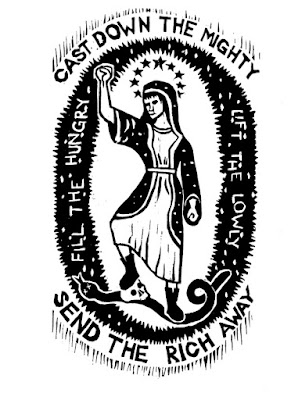
'Magnificat', by Ben Wildflower (Ben Wildflower Art)

This is the rough text of a last-minute sermon, covering for a colleague who had Covid. I preached from bullet-point notes on my phone, so said more than I can remember here. But it went something like this. (The readings are from Wilda Gafney's 'Women's Lectionary for the Whole Church', Year W, Advent 3 - Judges 13:2-7, Luke 1:46-56 - with a focus on Mary's Magnificat.)


The words of Mary's Magnificat found their way into the liturgy for Evening Prayer used by countless churches across the world. You might come across them sung with perfectly enunciated syllables by professionally-trained choirs in grand cathedrals, and the chapels of Oxford and Cambridge colleges, among the rich and powerful and privileged.

The words of Mary's Magnificat were also banned from being sung in church during the British occupation of India; banned by the repressive government of Guatemala in the 1980s, when the words became a popular song among the country's poorest; and banned by the military regime in Argentina, when the words started appearing on posters around the country's capital, the work of the Mothers of the Plaza de Mayo, whose children had all been 'disappeared' during the country's 'Dirty War'.

Mary's song, too often domesticated by our churches and our religion, is a song of revolution, of a world turned upside-down. It is a song that should shock us, if we pay careful attention to what Mary sings.

* * *

'Here I am,' says Mary to Gabriel, 'the hand-maid of the Lord'. A word that sounds quaint and oldy-worldy; pointing us perhaps to a dignified humility. Until, that is, we encounter Margaret Atwood's novel 'The Handmaid's Tale', where the word describes the role assigned to women in a dystopian near-future, dehumanised and reduced to nothing more than biological reproductive machines. When Wilda Gafney translates the Greek word in Luke's gospel as 'womb-slave', the shock value is stirred again. And for those who have known slavery, in their own life-experience or in the experience of their ancestors, the resonances are inescapable. In saying Yes to God, Mary chooses for herself a solidarity with the enslaved and oppressed and humiliated of the world.

Mary knows humiliation, of course. She is part of a humiliated, oppressed people. And the role she has been given, and taken on, and its increasingly inescapable visibility and physicality (her filling womb, her swelling belly), and the unbelievable story that goes with it... these are the makings of social shame, of an outcast... and so when Mary sings she sings out to God her own humiliation and that of her people, their hunger and longing for freedom... and she sings out too - echoing the song of her foremother Hannah - of all the women who have gone before her, who have been demeaned and diminished, treated as property, rendered voiceless, labelled 'barren' or 'whore' or worse... Mary sings with all of them, out of the humiliation that they share... 

And I'm pretty sure each of us knows something of that experience too, of being humiliated, shamed... something of what it feels like, in our bodies, minds and spirits... Mary sings with us too, out of our humiliations...

And yet, there is a boldness too in Mary's song, as she sings out her role, her calling, the world-changing vision and hope-made-real she has taken on bodily. If the Mary who sings here is a slave, then she is a slave of no one but God. God the compassionate, God in who carries in her womb the whole world (the Hebrew word for compassion and the Hebrew word for womb coming from the same root). God who is, herself, in the process of becoming human flesh and taking on the life-labour of the oppressed, the humiliated, the slave. This relationship between God and Mary, then, is nothing like any Master-slave relationship as we know it, but a partnership, a solidarity-in-fragile-flesh.

And Mary sings of a world that is about to turn, a world that is already turning. And those world-turnings are much more than a childless woman having a baby. They are the turnings of lives and a world...
- from shame to blessing
- from coercion to consent
- from exclusion to inclusion
- from powerlessness to agency
- from unheard voices to bold singing
- from hunger to being well-fed
- from oppression to freedom
- from nobodies to somebodies (the title, and this is no coincidence, of a book by our friend and teacher, the Black Theologian Professor Anthony Reddie - Mary's Magnificat is a song of racial justice too)

* * *

And pay attention to what justice looks like in Mary's song: she sings not just of the hungry fed and the lowly lifted up, but of the mighty brought down from their thrones and the rich sent away empty. This is true justice, God's justice - the kind of "levelling up" that our governing politicians are surely not remotely willing to embrace.

Is it a simple reversal, simply turning the whole power structure upside-down? With the rich and powerful humiliated, and the 'meek and lowly' exalted to positions of wealth, power and privilege? What does Jesus mean, in the Beatitudes, when he tells us the meek will inherit the earth?

If we had been following our usual lectionary today, we would have heard the prophetic challenge not of Mary but of John the Baptist: "you brood of vipers", he spat, calling out the hypocrisy, greed and selfishness of the powerful, and their indifference to the poor and marginalised. The turnings of Mary's Magnificat will indeed bring the powerful down to earth, and probably with a bump. But I'm not sure that means that they simply take the place of the previously-humiliated in an eternal gutter. And I think there are at least two clues that point us in a different direction...

First, let's remember where, and with whom, Mary sings her song. She has travelled into the hill country, to find sanctuary with Elizabeth, her cousin, her 'kinswoman'. She is in a place of safety, in a relationship of solidarity, of shared experience, of kinship. And the kinship and solidarity between these women, is the fertile womb of a kinship and solidarity between their children, John and Jesus, who will call their hearers to repent, to turn from their destructive ways, and to turn towards kinship, as children of God.

And our second clue is again in the roots of the words at play here: because both 'humiliation' and 'humble' are rooted in humus... the leaf-mould, the compost, where all that is hard is broken open and broken down, where all that is alive is being decomposed, where everything that is rejected as waste finds a home and brings its unique contribution, where richness comes with a powerful smell, where the creepy-crawlies that are so often despised are the ones who do the vital work, where new life comes not beyond the shit, but in the midst of it. 'Down to earth' is the only place that we and all others should be. This is where we are pushed to acknowledge that our kin include all kinds of creatures and things that we have been doing our very best to avoid and ignore. This is where Mary's Magnificat comes to life: in the middle of the compost heap, God calls us to hear her song, and to follow her lead towards kinship, solidarity and hope.

Glory in fragility: a sermon for Midnight Mass

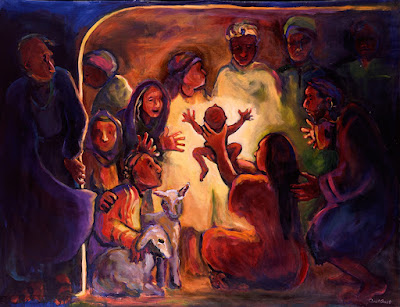
'Nativity', by Carol Aust (Liturgical Paintings | Carol Aust Fine Art)

This is roughly the sermon I'll be preaching at Midnight Mass at Hodge Hill Church this year. I never usually finish preparing so early - but we're sending out our 'worship at home' packs on Wednesday (as we have done every week since March 2020), so I had to get my act together. I cried writing this, and I may cry delivering it. I don't often weave the stories of my nearest and dearest into my preaching, but this time it felt right to do so, in the spirit of the message itself. 

It was our first baby. Janey had been pregnant about 18 weeks – some time after the first scan, not long until the second. But something wasn’t quite right. Janey had been bleeding a lot, so we phoned the hospital, and they called us in to check her over. I vividly remember the short car journey together to Birmingham Women’s Hospital: mostly in silence, but we both knew what we weren’t daring to say. I remember us going into a small cubicle with the obstetric nurse, her friendly warning that the gel would be cold on Janey’s tummy, the foetal heart monitor making contact, and then the wait… the silence… the long, increasingly uncomfortable silence, as we listened for any sound… I remember Janey and I looking at each other. I remember realising I was holding my breath, for what felt like an eternity… and then there it was: the quick, steady pulsing of a baby’s heart. The sound of a tiny human life. Fragile life, and yet clearly more resilient than we had feared.

13 years on, the day before the end of a year marked by a global pandemic and recurring lockdowns. But it’s snowing, so our family of 4 and some of our best friends are out hunting snowy slopes for sledging fun. And then in an instant the screams of laughter turn into shouts of fear, and in another instant I’m down the slope and bringing our 9-year-old daughter back to consciousness and holding her, desperately trying to keep her awake. The waiting, this time, is for the paramedics, who take close to an hour to find us. It feels much, much longer than that, and it is terrifying. In the hours, days and weeks that follow, there is more waiting, as immensely skilled medical professionals do their work of looking and watching and treating and checking, and surrounding us with their care. And around the four of us, and around the professionals, there is a wider circle, of family and friends, neighbours and church community and a jumble of wider networks of connection, with us, holding us, in love, and prayer, and practical care and support. With us, holding us in our fragility, of body, mind and spirit; with us, holding us and upholding us, and not letting us go.

* * *

All of us know something of that fragility of body, mind and spirit, whether it’s become inescapable for us through some of life’s more traumatic events, or through illness, or ageing. In our relationships beyond our own families – in our church community, in our community-building work in some of our neighbourhoods here, and in other places too – loved ones have died, people who’ve been hugely active have had to step back from things, relationships have come under strain or have broken, much-valued aspects of community life have been put on hold, or have slipped away into more and more distant memory, hoped-for developments have been stalled, pretty much everything is smaller, and more difficult, and more precarious, than we’d like it to be.

We know what fragility feels like, how in a moment we can suddenly be plunged into it, how we can try our best to defend against it, to build in strength and resilience, but discover, often very slowly, that fragility is just a part of reality that stubbornly refuses to go away. And as human beings together, we are learning, some of us very slowly, that the world in which we all live and in which we are entangled and inescapably interdependent, is also a fragile ecosystem that won’t just endlessly tolerate our extreme activities of extraction, consumption, pollution and destruction.

Fragility marks reality, and there is no erasing or escaping it. But to tell ourselves we ‘just have to deal with it’ would be too cold and hard. And unjust – because fragility is more unavoidable part of daily life for some people than for others. While holding it at bay is like holding back the tide, some people have the privilege of higher and stronger flood defences against it. So we need a wisdom in dealing with fragility that is rooted in justice: grounded in a hearing and seeing of all God’s children, all God’s creatures – so that no cry of pain, or fear, or loneliness, or hunger, or suffering goes unheard. We need a wisdom in dealing with fragility that is patient: that knows that when we rush, we break things – and people, and ourselves – and that fragility in all its forms needs of us a slow, attentive carefulness. And more than either of these, we need a wisdom in dealing with fragility that has love woven through it: a love that can be tender with the small and the wounded and the hurting; a love that can plumb our shared depths with empathy and compassion; a love that hopes, believes, rejoices, fiercely, in the beauty and abundant possibility that is to be found in the midst of the fragile; a love that is with us in the midst of fragility, that waits and watches with us through the darkest nights, a love that holds us and upholds us and will not let us go.

And that is what the good news of Christmas is. The birth of Emmanuel: God-with-us. The Word and Wisdom of God who spoke creation into being, who brought all things to life… becoming fragile flesh and blood, becoming a fragile human baby, and in the process not becoming any less God, but if anything becoming even more God. ‘The glory as of a parent’s only child’: as if the glory of God is glimpsed most fully in the fragility of creaturely flesh – that is exactly what the good news of Christmas is. If God-in-Jesus is Saviour – which we claim he is – he doesn’t save us from our fleshly fragility, but in it. He saves us by being with us in our fragile flesh, with us in our tears and brokenness and suffering and fear, and with us too as light: light that helps us more clearly see God’s presence in our midst; light that helps us more clearly see each other, as human and creature-kin; light that helps us more clearly see, in our fleshly fragility, the beauty and hope and abundant, divine possibility that are some of the meanings of the word glory.

* * *

And we have seen that glory…

…in a youth worker patiently journeying with a young woman over many years: being with her through the anxieties of pregnancy and the steep learning curve of motherhood, as she discovers what it means to be a ‘good-enough parent’; being with her as she begins to discover that parenthood need not be the only thing that defines her, but that she can find her own voice, find her confidence to travel, find her horizons widening – even as far as the other side of the world… a youth worker who can journey with her, and then cheer her on from a distance as she begins to journey with and mentor others, as she has been journeyed with and mentored herself…

And we have seen that glory…

…in a pantry volunteer who takes time and care, every week, to greet the nervous, jumpy woman with a big smile and a cheerful ‘hello!’, and who always stays alert to that day when the woman is ready to sit down and talk, and share something of what’s going on in her life right now; not to ‘fix’ her, but so that she feels heard, maybe for the first time in a very long time – so that she knows that there is someone, maybe many someones, who are with her in the struggles; that she’s not alone…

And we have seen that glory…

…in those who will show up to the last-minute, chaotic memorial service of someone they barely knew, but because they want to support the friend who is grieving the most; and they know that being there, just being there, will mean the world to him…

And we have seen that glory…

…in those who will muck in together to sweep up the glass from the break-in, for the first, and the second, and the third time, and turn it from a wearing attack into an opportunity for laughter, and camaraderie, and supporting those who are feeling down, and remembering what faith and hope and love look like…

And we have seen that glory…

…in grabbing a spade and getting stuck in to some hard ground, side by side with neighbours from half a dozen different countries, from toddlers to pensioners, to turn a neglected communal garden into a space of beauty, a space for play and rest and friendship…

And we have seen that glory…

…in coming together to sing carols outside the house of someone who’s finding it increasingly difficult to get out beyond her own front door, but who knows that she’s still part of a community of love and care and prayer, and that even when we’re separated, and even when that separation hurts on both sides, we are longing and loving and praying together, with her prayers as valued as any others…

And we have seen that glory…

…in the midst of a protest against the global catastrophe that is climate change, calling for radical, courageous change from governments as well as individuals… walking with a few banners through central Birmingham, but joining in solidarity with walkers and banners and voices from across the global South, who are already measuring the effects of climate change in terms of land and lives lost forever…

And we have seen that glory…

…in a hospital chaplain sitting quietly with an anxious dad, while their daughter is in surgery; a dad suddenly, unexpectedly thrown by the moment the general anaesthetic made his child’s eyes close as if they might never again wake up; a chaplain with the gift of just being there in the right place at the right time, and knowing what to say, and when he needs to not say anything at all…

And we have seen that glory…

The glory of God-with-us, where the word ‘God’ is important (obviously), and the word ‘us’ is important too – but so is the small, apparently insignificant word ‘with’. ‘With’ is the good news of Christmas. ‘With’ is what we’ve been waiting for through Advent, what we’ve glimpsed by candle-light in Advent’s stories, what we’ve whispered and prayed and sung every time the words “O come…” have passed our lips.

“Rejoice, favoured one! The Most High God is with you,” said the angel Gabriel to Mary.

It is with her cousin, Elizabeth, that the frightened Mary finds sanctuary for the early months of her pregnancy, as together they began to make sense of the new life that was stirring inside them.

For Joseph, it is staying with Mary, even though her child is not his, that is his God-given calling.

And now, God-with-us, full of grace and truth and radiant with glory, comes to be with us in an animal feeding trough in an irrelevant little town in an occupied country on the edge of the Roman Empire…

…and God-with-us, full of grace and truth and radiant with glory, comes to be with us in the small and fragile, the messy and chaotic, the overlooked and ground-down, the weary and tearful, in our time, in our places, in our communities, in our homes, in our hearts.

And if our eyes are open enough, if the waiting of our Advent – however long this Advent might have been – has helped develop our night vision, helped us see even when it’s really dark, then we might just catch a glimpse of the glory of God-with-us – in each other, in our midst, in the world, in ourselves – tonight, and in the days and nights to come.

“O come to us, abide with us, our Lord Emmanuel.”